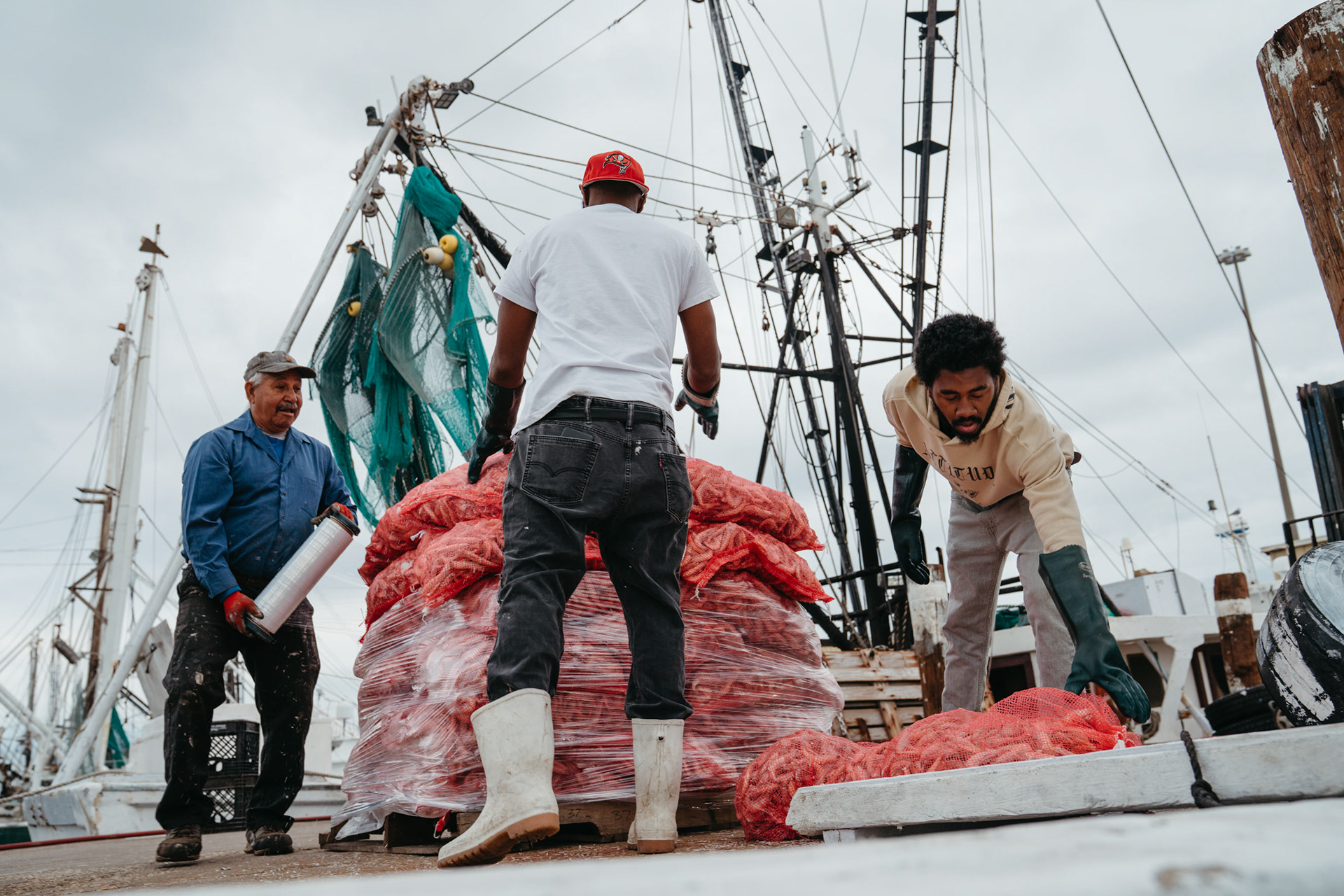
Derrick and D'Angelo stack bags of shrimp on pallets at Versaggi Shrimp Co. docks / Adrian O'Farrill
Despite existential challenges, Tampa’s Versaggi Shrimp Co. continues to bring wild-caught seafood to Bay area tables
The Tampa Tribune said that in 1969, the company had 33 boats. Today, just five boats call a single port authority dock home.
By: Adrian O'Farrill
Tucked away behind the shadow of downtown Tampa and docked patiently on the pier of the Tampa Shrimp Docks, a handful of rusty boats await their next month-long voyage. Justin Versaggi, the fourth-generation leader of the Versaggi Shrimp Co. sits in his office, unsure if the next ship he sends out will make a profit.
The over-century-old family business which originated in Fernandina Beach has seen a gradual decline from its heyday, when its shrimping empire stretched from Texas, along the Gulf Coast, and down to South America, with ports in French Guiana and Brazil. The Tampa Tribune said that in 1969, the company had 33 boats. Today, just five boats call a single port authority dock home.
“There’s so many small coastal community families that earn a living on the water,” said Versaggi. “And the way we’re headed right now, it’s going to be extinct. And once it’s gone, you can’t get it back.”
The docks sit at the halfway point of the Licata Bridge on Causeway Boulevard, less than a 10-minute drive from the heart of downtown. Despite its proximity to the heart of Tampa’s urban life, public awareness of the shrimp docks is nearly non-existent.
“I don’t think I’ve ever been there. I feel bad to tell you,” Andrew Huse, Special Collections Librarian at the University of South Florida and food historian, told Creative Loafing Tampa Bay. “It’s just something that’s not in the discourse. It’s out of sight, out of mind. If the shrimp docks go away, it’s sad to say but most people didn’t notice them in the first place.”
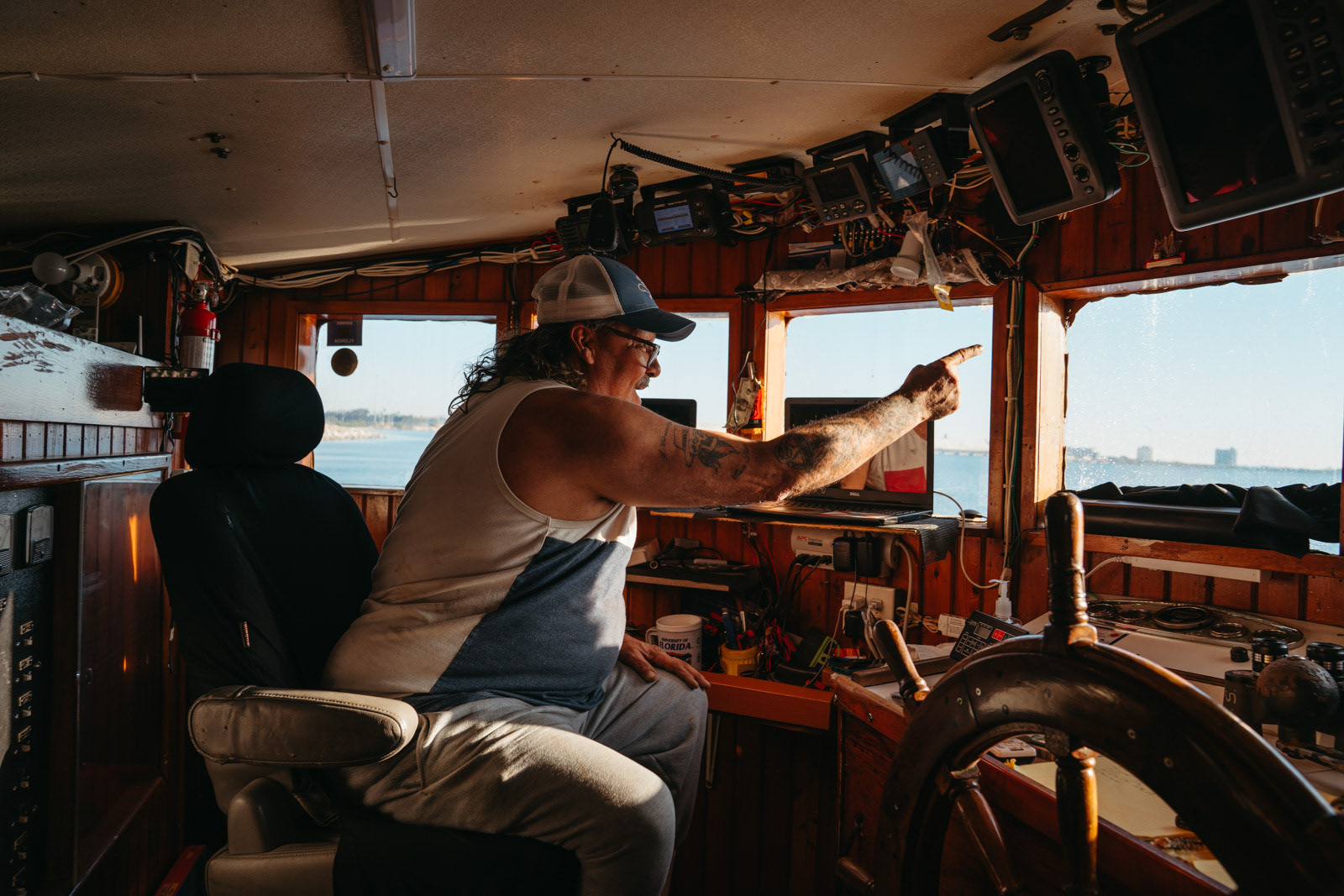
Captain Jimmy Schrader told Justin Versaggi, 'I've never caught more shrimp in my life and made less money.' / Adrian O'Farrill
The docks are open to the public, with Versaggi and the neighboring business Superior Seafoods Inc. both selling by the box. Yet, while foot traffic is sparse, there is a larger issue that Huse believes is ingrained in the food culture.
“People don’t value wild-caught shrimp,” said Huse.
The same cultural sentiment is shared by Jon Atanacio, Executive Chef at South Tampa’s Epicurean Hotel, who has made sure Versaggi shrimp has been on the menu since he came to the restaurant.
“No insult to anyone, but seafood has always been just part of a menu—not the whole thing. It’s not what people completely focus on, which I think is crazy,” said Atanacio.
It’s a point that stems from the recently exposed sordid seafood culture in Tampa Bay. Using genetic sampling, SeaD Consulting, a seafood genetic testing company, found in a recent study “that a mere two out of 44 sampled restaurants serve authentic, wild-caught Gulf shrimp” across Tampa and St. Petersburg. The study was funded by the Southern Shrimp Alliance (SSA), which includes shrimp companies from Alabama, Florida, Georgia, Louisiana, Mississippi, North Carolina, South Carolina, and Texas.
“It’s fraud. And people need to be held accountable,” said Versaggi. “It further depresses our ability to stand up on a level playing field.” His uncle, Sal Versaggi, is a founding member of the SSA.
For Versaggi, the answer to why people have a disconnect with their seafood is simple.
“They’ve never actually had wild-caught shrimp,” said Versaggi.
Texturally and flavor-wise, Chef Atanacio said there is nothing better you can get in Tampa Bay. He described the shrimp as silky, delicate, and sweeter than most other shrimp.
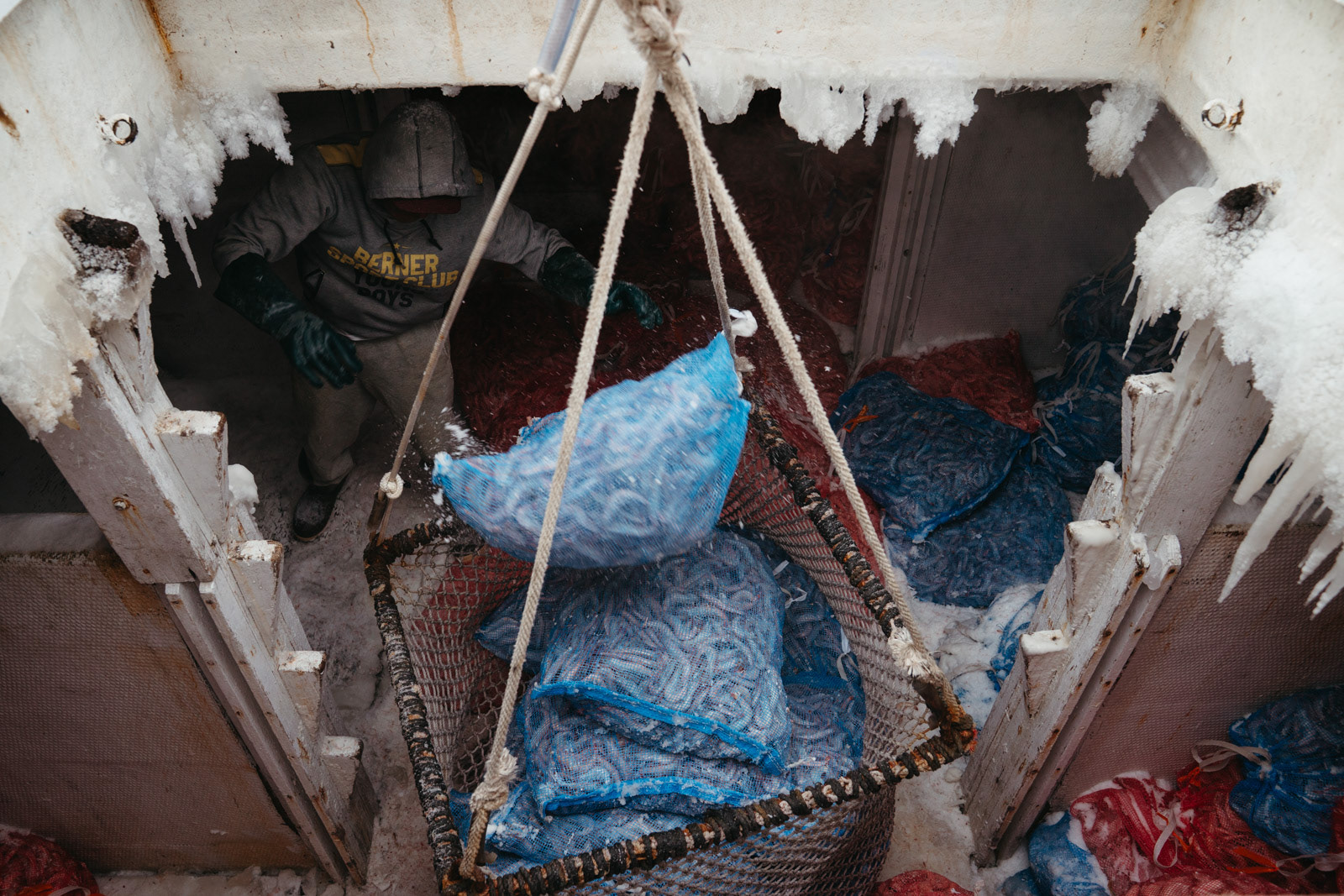
A worker lobs bags of shrimp in the sub-zero frozen cargo to be hoisted up by rope to the docks / Adrian O'Farrill
Derick Hodgson, who’s worked the docks for Versaggi for 15 years, called Key West Pinks, “el oro del mar,” or “the gold of the sea.”
“Hands down, the best shrimp I’ve ever had,” said Atanacio, admitting he even buys it for personal use at home. But without a central fish market in Tampa, he said it’s hard for restaurants to implement local seafood. Rather than having product flown directly to Tampa, Atanacio, like many other chefs, have to spread out and purchase from other hubs like Orlando, driving up costs.
The Epicurean is one of a few restaurants that partner with Versaggi, which includes the likes of Rocca, Shrimp & Co., The Boozy Pig, and Frenchy’s Stone Crab and Seafood Market. If there were a fresh daily fish market in Tampa, Atanacio believes more restaurants would be able to implement fresh seafood into their menu.
Before living in Tampa, Atanacio worked at a New York City seafood restaurant. It’s there that he gained an appreciation for locally sourced seafood, with places like the Fulton Fish Market bringing fresh product daily. “Here, there’s no direct supply, which is crazy because we’re surrounded by water,” he added.
That grand irony, Huse attributes to poor planning during Tampa’s growth years. He said, dating back to the ‘20s, Tampa was unplanned, sprouting as the needs came. During that economic boom, Tampa’s waterfront was an afterthought.
“Tampa has never been proud of its waterfront, and it’s never made it a priority to make it accessible,” said Huse. And sadly, the shrimp docks were hidden from any modern waterfront access.
“It’s a shame because those shrimp docks could be a little tourist destination. They’ve been here for this long. People go to the Fulton Fish Market or The Wharf in Washington,” said Huse.
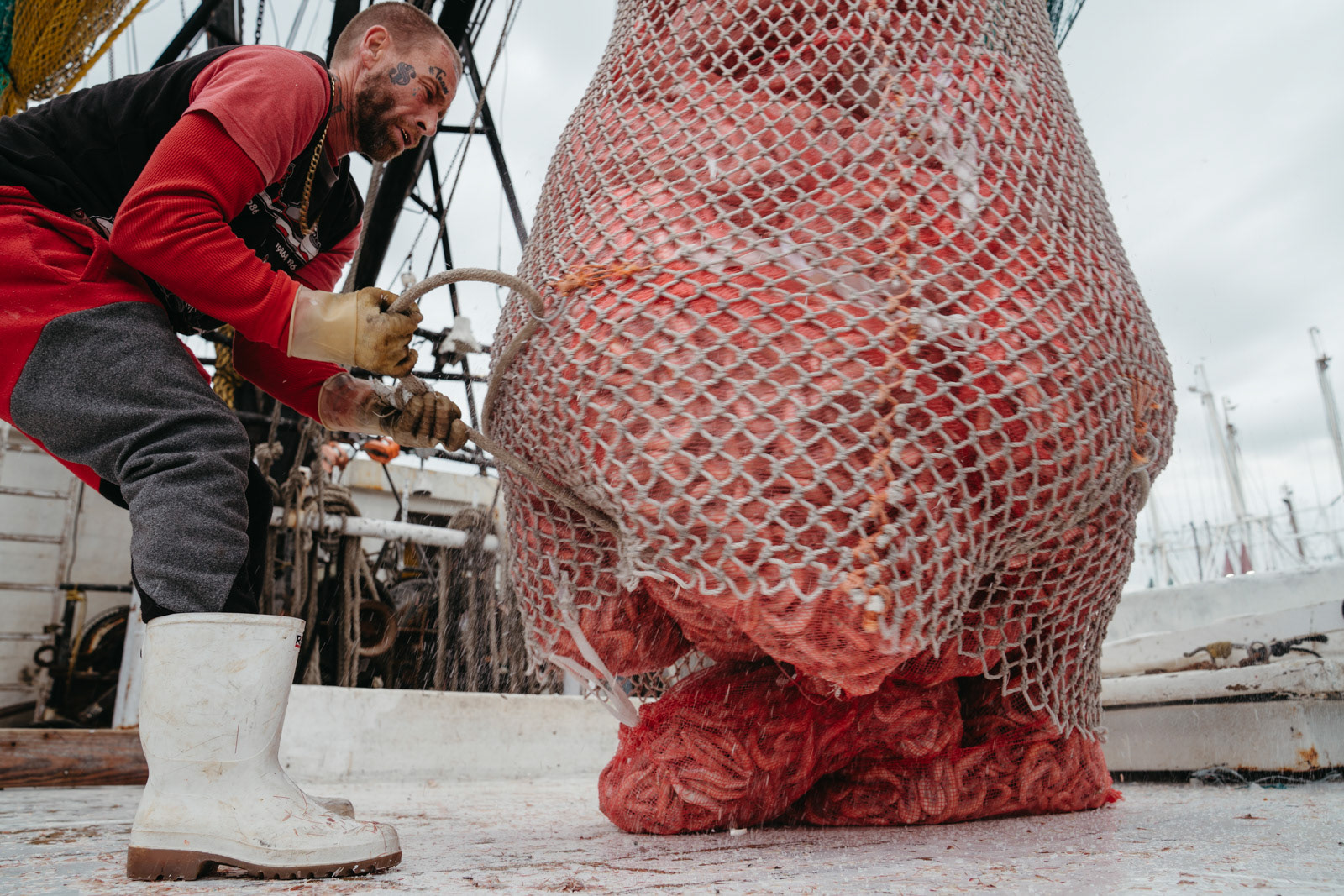
JJ unloads bags of shrimp on the deck before they get sorted out for packing / Adrian O'Farrill
Apart from how people think about their seafood, the list of obstacles the Versaggi’s have faced has grown over the years. There was a time, Versaggi said, when the cost of fuel was not a worry. Today, he said it’s the biggest line item when sending out a ship.
The ships, built by St. Augustine Trawlers, store 7,000 gallons of fuel for the one-month voyages. All in with gas and supplies for the crew – each trip starts with tens of thousands of dollars in costs by default. Whether it returns with enough shrimp to turn over those costs is not guaranteed.
“There was a period of time where I was sending boats out, having absolutely no confidence that we could sell the product that we were going to source,” said Versaggi.
Unlike farmers, who receive assistance from the Department of Agriculture (USDA), Versaggi said they don’t qualify for risk mitigation. When asked why shrimpers don’t get the same protection, the USDA told CL that assistance only applies to aquaculture farms. The very act of “wild-caught” excludes businesses like Versaggi.
“We’re farmers of the sea, but we don’t get the same subsidies,” said Versaggi.
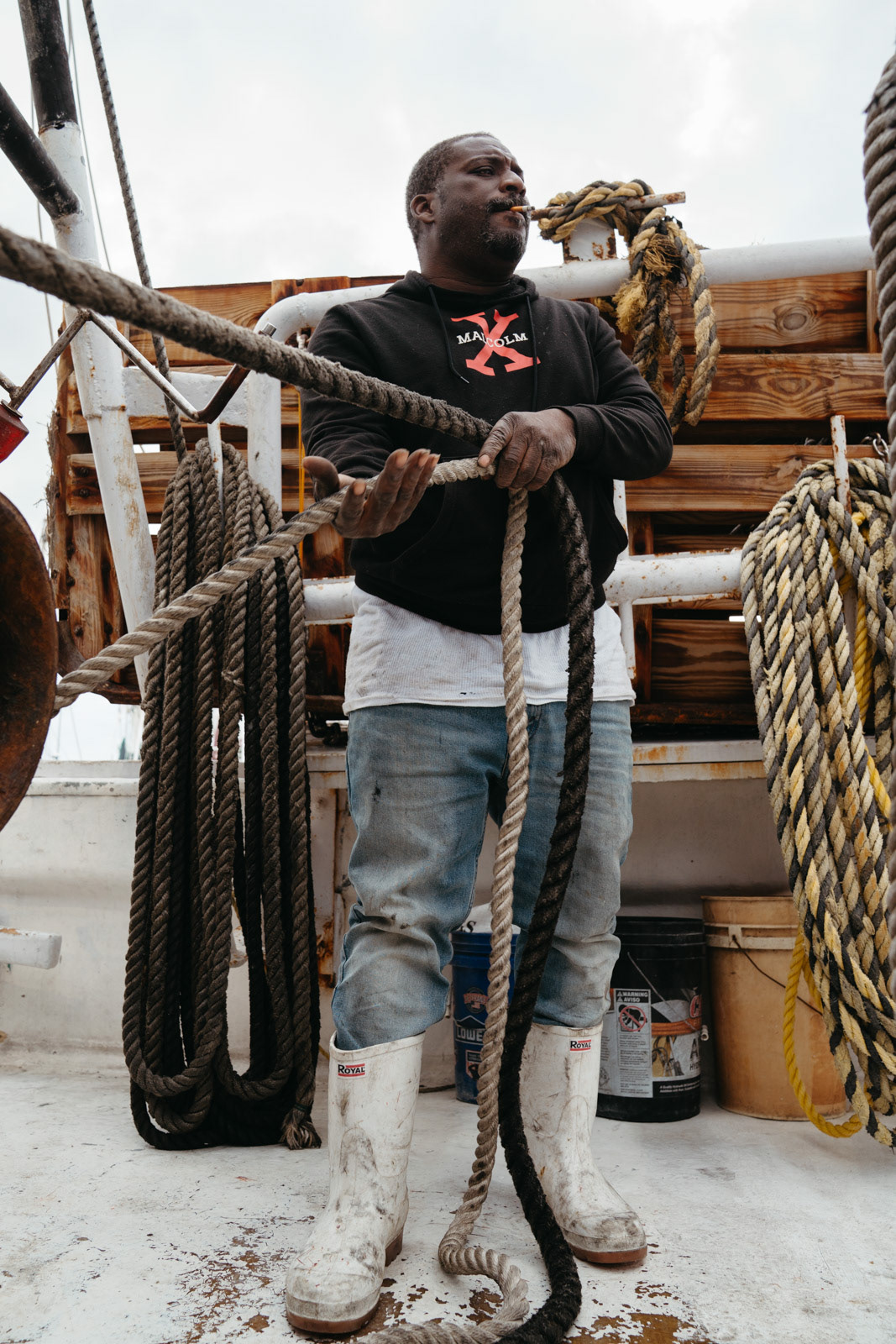
Charlie hoists up the bags of frozen shrimp from the cargo / Adrian O'Farrill
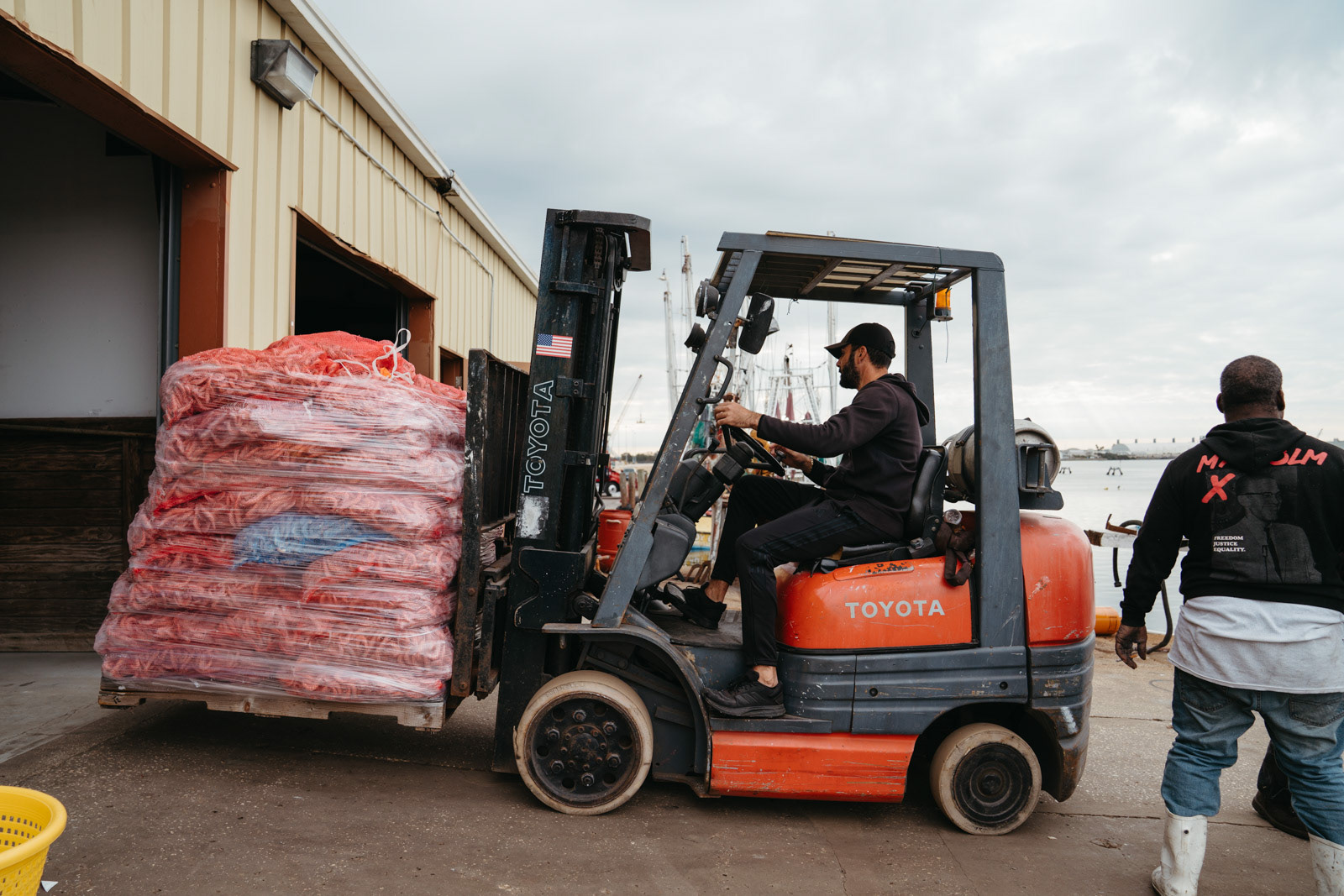
Justin Versaggi brings in bags of shrimp on a forklift to get sorted and packed / Adrian O'Farrill
However, the real enemy for shrimpers comes from an ocean far away in the form of imported shrimp, which has drastically slashed the demand for locally sourced shrimp.
“We have more shrimp being imported into our country than the consumption rate affords,” said Versaggi. “That right there is all you need to know. If we limit imports, forget the high diesel price.”
Data from the National Oceanic and Atmospheric Administration (NOAA) shows that the number one exporter of shrimp to the U.S. was India with over $2.3 billion worth of product in 2023. But it’s not just shrimp; the Food and Drug Administration says 94% of the seafood Americans consume is imported from overseas.
Last year, NOAA Fisheries acknowledged that “the low prices of shrimp make it too expensive to justify the costs of a trip; these communities are suffering as a result.”
Those low prices, Versaggi said, he realized reached a painful bottom a couple years ago when Captain Jimmy Schrader told him, “I've never caught more shrimp in my life and made less money.”
“And I just thought about that as the owner and as his boss. I feel like I was letting him down,” said Versaggi.
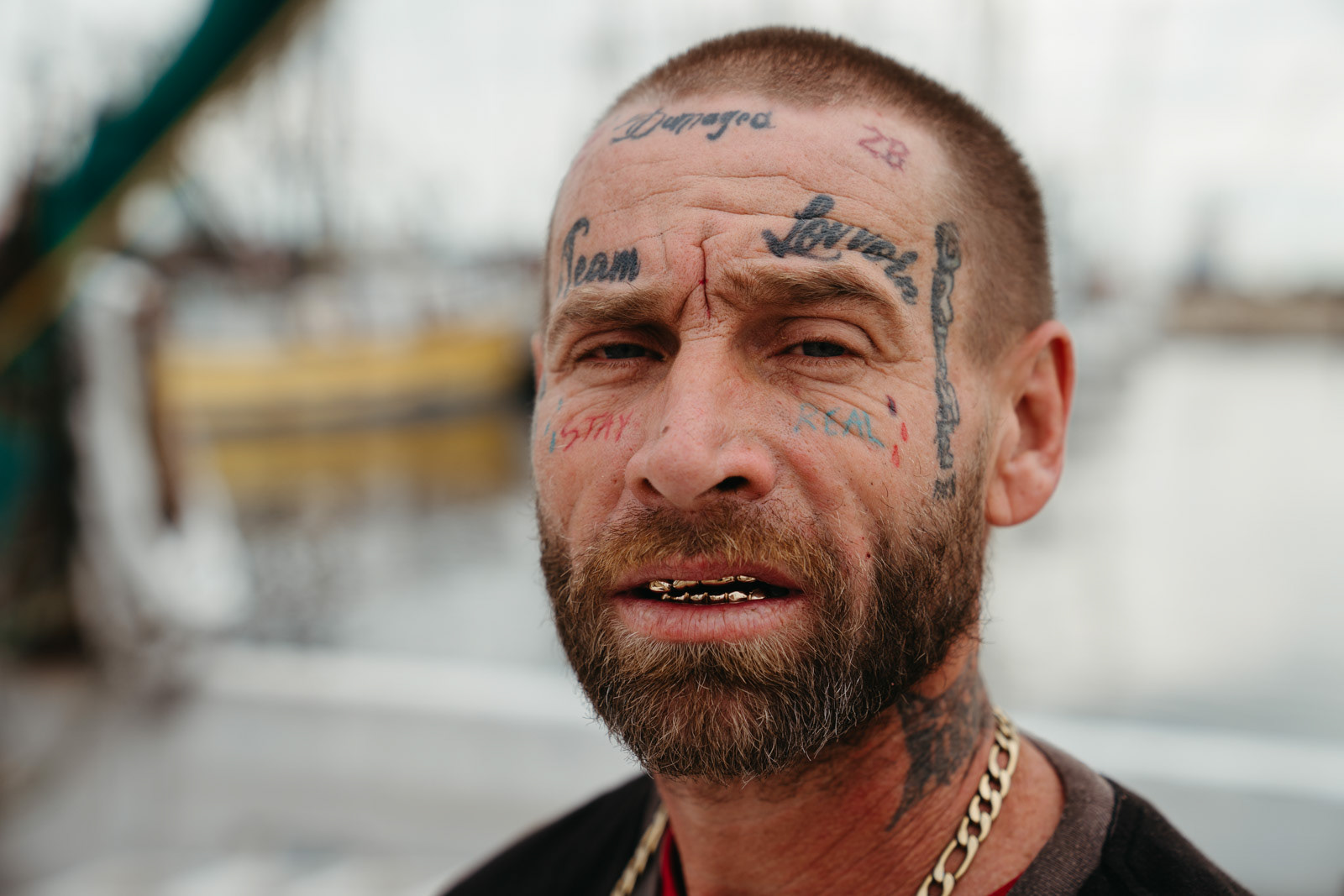
JJ at the Versaggi shrimp docks / Adrian O'Farrill
With NOAA’s recent interest in the welfare of local shrimpers, Versaggi is hopeful that there may be changes in Washington, where he believes the only way to have a future for shrimpers relies on change in legislation.
The current situation has already forced Versaggi to make a difficult decision. For the first time in its history, his fleet is uninsured.
“Imagine if I go out there and three boats sink, I get nothing,” said Versaggi.
It has been the case for a while that the Versaggi’s have been relying on family and faith to get by. Faith that the uninsured boats will return with a profit. Faith as the paint chips and the metal rusts aboard the fleet, knowing that no new ships are being made to replace them. And faith that someday, someone will realize it is a culture worth saving.
As Versaggi said, the life of a shrimper is a life of solidarity.
“It's not for everybody, but it's for the Versaggi’s, I can tell you that.”
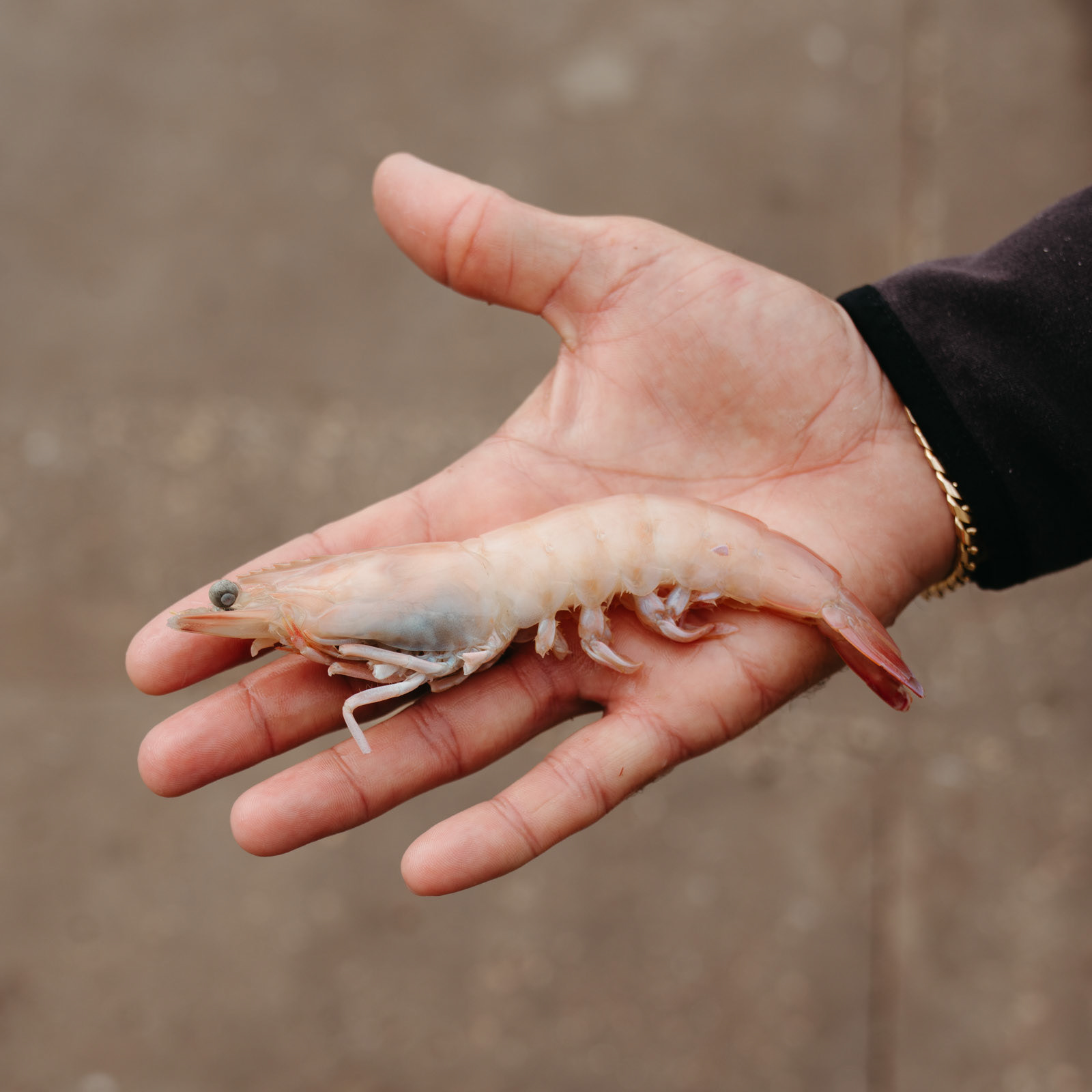
Justin holds a shrimp on the palm of his hand / Adrian O'Farrill