
The milky way over Tucson as seen from Windy Point / Adrian O'Farrill
'Ghost spacecraft': NASA budget cuts threaten UA's OSIRIS & other missions
By: Adrian O'Farrill
In less than four years, an asteroid the size of the Empire State Building will approach the Earth, narrowly passing closer than some orbiting satellites. A NASA spacecraft — OSIRIS-APEX — is already patiently waiting, orbiting the sun, to study the space rock as it approaches.
But it might never get the chance.
The proposed 2026 NASA budget calls for defunding the University of Arizona-led space mission even though it's already midway through its operation. Six other UA-led missions are also at risk of losing all their funding.
“It would be a ghost spacecraft out there,” said Dr. Daniella Mendoza DellaGiustina, director of OSIRIS-APEX. “If there was nobody actively operating it, it would get too close to the sun to continue functioning.”
The spacecraft named Origins, Spectral Interpretation, Resource Identification and Security – Apophis Explorer (OSIRIS-APEX) is currently on an extended mission to the asteroid named Apophis. It’s tasked with advancing planetary defense strategies by observing how Apophis behaves on such a close fly-by. An asteroid of this size passing so close to Earth has not occurred in recorded history. When it was first discovered in 2004, Apophis was initially thought to pose an impact risk; a regional devastator, but not quite a planet killer.
DellaGiustina said the impact probability, thankfully, now sits at 7 in 1 billion.
But it will still be close enough to allow 2 billion people from Europe to North Africa to get a view with the naked eye on the night of April 13, 2029. Then, for the next 18 months, APEX and Apophis would fly side by side with each other, allowing the mission's crew on Earth to observe the asteroid up close.
What the mission learns from Apophis could help safeguard the planet from asteroid threats in the near future. DellaGiustina said that mission aligns with the current administration's priorities for NASA, so the decision to defund a defense-oriented project is startling.

Dani DellaGiustina, director of OSIRIS-APEX at the University of Arizona / Adrian O'Farrill
“My sense is that this decision was made at a lower level,” said DellaGiustina. “I cannot tell you why APEX is on the chopping block.”
NASA has different programs that handle different missions. In the case of the space science program budget, NASA’s proposal explains that in order to be “in line with the administration’s objectives of returning to the Moon before China and putting a man on Mars, the budget would reduce lower priority research and terminate unaffordable missions.”
Every single mission program except human exploration would see cuts as deep as nearly 50%.
“This administration has had a full frontal assault on science; don't believe in science,” said U.S. Sen. Mark Kelly, a former NASA astronaut. The Democratic lawmaker from Arizona told the Tucson Sentinel last week that the reason this budget proposal is so draconian is the White House.
“It's important to recognize that the reason that we have the biggest economy that this planet has ever seen, is because of science,” Kelly said in an interview. “Scientific research that we do in this country creates industries. We create entire industries out of nothing because we invest in scientific research like the UA does, and this president is cutting funding to that scientific research.”
NASA's budget for fiscal year 2026 is a part of the appropriations bill being drafted in Congress. U.S. Rep. Juan Ciscomani, a Southern Arizona Republican, is part of the House Appropriations Committee, which is tasked with laying out the spending bill before the rest of the House votes on it. Ciscomani's office didn't provide a response to the Sentinel's questions about the local impact of NASA budget cuts.
The shift in the budget reflects President Donald Trump's inaugural address, when he called for the pursuit of “our manifest destiny into the stars, launching American astronauts to plant the Stars and Stripes on the planet Mars.”
“The president understands the power of symbols and is drawn to the idea of humans landing on Mars while he's in office,” said Casey Dreier, chief of policy at the Planetary Society. “That's functionally impossible in any scenario at this point, but I don't think a lot of time is being spent thinking about NASA in a detailed way.”
With the agency's programs facing the steepest budget cut in its history, NASA does not have a confirmed administrator. Effectively, Dreier said the agency has weakened during that process.
“No one knows exactly who is in charge of space policy at the White House,” said Dreier.

U.S. Sen. Mark Kelly spoke to the Sentinel about his perspective on the NASA budget proposals / Adrian O'Farrill
Apart from Planetary Science, which APEX is a part of, the UA also has a mission involved in heliophysics which deals with the sun. Both are branches of NASA’s Science Mission Directorate, and Kristopher Klein, deputy principal investigator for HelioSwarm, is also at risk of his mission being defunded. He has been appealing to Congress for support, but appealing to NASA looks different with only an acting administrator.
“Because the head is still an interim, she has relatively little power,” said Klein. “Which means that (NASA) does not have the same levers to use as it could if it was under a full administrator.”
His mission involves sending nine different spacecraft up to the edge of Earth's atmosphere, where it turns into outer space. There, the swarm will study the way the sun's solar wind affects satellites and communication equipment and measure fluctuations in Earth’s magnetic field.
Those solar winds, which are the constant projection of charged particles from the sun, sometimes erupt in larger solar flares, which Klein said is imperative to keep track of, not just because they could damage electrical equipment on Earth, but it could endanger astronauts on missions in space.
“There was an incredibly large flare that happened between Apollo 16 and 17. Had the astronauts been on the moon when it was happening, as opposed to right before or right after, they would have received a lethal dose of radiation,” said Klein.
Being able to observe and forecast those solar flares, Klein said, is key to protecting astronauts if the current administration is intent on sending astronauts to the Moon or Mars.
And while Dreier said the budget cuts are a direct interpretation of the president's desire to go to Mars, there is absolutely no consideration or rationale behind the policymaking. The only thing NASA can do with an anemic budget is make hard decisions.
“If you're a program manager at NASA and you've just lost a half to a third of your budget, what do you cut first? You cut the projects that are longest into their lives and the projects that are earliest in their development cycles,” said Dreier.
For HelioSwarm, the spacecraft themselves have not been built and would not launch until 2029.
In APEX’s case, it technically already fulfilled its original duty. Before its ongoing current objective, the spacecraft went by the name OSIRIS-REX as it visited the asteroid Bennu and returned samples back to Earth in 2023.
“We never planned for an extended mission, and around 2021 we started the process of thinking about, OK, what can we do with this incredible vehicle,” said DellaGiustina. So the team sent a proposal to NASA to allow the $1 billion spacecraft to remain in operation.
The only thing the craft could do within the short time after the sample return was to send it to Apophis. NASA said yes; REX became APEX and was redirected for the new mission.
Asteroids such as Bennu and Apophis are remnants of the early solar system, containing the blueprints of matter that were present at the time. Essentially, they’re material left over from protoplanets that were forming before Earth even existed. In the case of Bennu, it’s theorized that a young molten planet was struck by another body and caused the ejection of all its matter—some of which was hypothesized to contain the possible origins of life.
Upon sample returns, scientists discovered that Bennu contained naturally forming organic chemicals, amino acids, and even water.
“Bennu is dominated by water-bearing clay minerals, and it is also full of organic compounds that are the precursors to life,” said DellaGiustina.
And Apophis might be similar, the only downside is that REX used up its only sampling mechanism on Bennu, rendering it unusable. It still has an arm, which the crew intends to use to agitate the regolith along with the thrusters to see how the surface behaves in case someday, they try to deflect a potential impact-risk asteroid.
The $200 million mission has used only about 10% of its budget thus far. Even if the mission was defunded, DellaGiustina said the remaining budget is pennies on the dollar for the amount of revenue that the Tucson space industry brings to the area.

Kristopher Klein, deputy principal investigator for HelioSwarm / Adrian O'Farrill
“In Southern Arizona, we basically bring the same economic value as holding a Super Bowl here every other year. And that includes my department, Lunar and Planetary Labs,” said DellaGiustina.
All together, the space science work at the UA employs about 3,300 people, bringing in about $275 million per year.
“I don't know what will happen if all these missions are called for termination, all of which are operating in space right now,” said DellaGiustina.
If the cuts were to take effect as they are written, Dreier believes that accounting for all the projects that are in the pipeline and even millions of miles away in deep space, ultimately we would lose at least a decade of space science progress.
DellaGiustina is encouraging her team to stay focused and prepare for the Earth gravity assist in September that would slingshot APEX into a steady orbit. Meanwhile, she has been contacting other projects across the region trying to find homes for her entire team if they get laid off.
“I feel like I very much owe it to my team who are the smartest, most phenomenal people, and I am so privileged to work with and lead to do my best for them. I'm not going to quit until we're done,” she said.
The federal fiscal year starts on October 1, meaning that the most pertinent due date for a decision on the budget proposal would have to be around then, according to Dreier.
“There's probably some give to that, but it's hard to say an exact date. They're not being open or transparent about these activities, so it's hard to say what exactly is going on behind the scenes,” said Dreier.
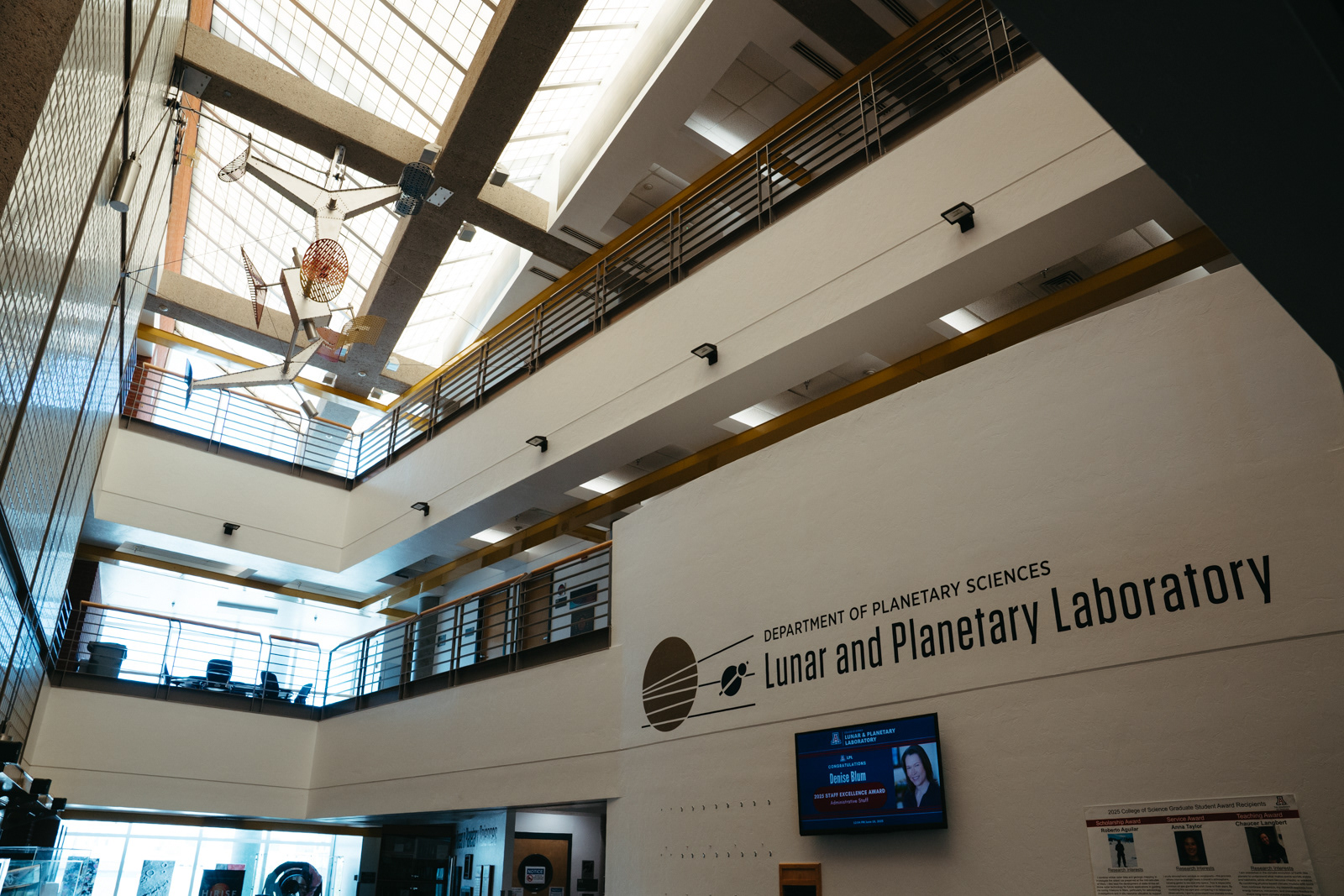
Lunar and Planetary Labs at the University of Arizona / Adrian O'Farrill